


Every Size, Not Just Large Portfolios
A registered agent handling five client companies has the same LEI obligations per entity as one managing five hundred, and every client needs a current LEI.

Select Your Jurisdiction
Currently selected: Canada|

Search region…
Corporate service providers, registered agents and business administration firms are increasingly responsible for ensuring their client entities hold active, compliant LEI codes, alongside every other filing they already manage. LEI System gives you one account to register, renew and track LEI codes across an entire client portfolio, with volume pricing as that portfolio grows, backed by GLEIF accreditation and a 150-jurisdiction reach.


LEI System is an official LEI Registration Agent
Latest LEIs issued:
984500F4100AB5956011 |  QUINNCOM INTERNATIONAL PTY LTD
The requirement reaches every client entity a provider manages, and
relevance has nothing to do with company size.
A registered agent handling five client companies has the same LEI obligations per entity as one managing five hundred, and every client needs a current LEI.
Agents forming and maintaining companies on behalf of clients increasingly handle LEI registration as part of the same service relationship.
Firms providing ongoing corporate administration use LEI reference data to keep client entity records accurate and current across every filing they manage.
Providers offering regulatory compliance as a service add LEI management as a natural extension of the filings and registrations they already handle.
Law firms administering client company structures use LEI codes to keep those entities correctly and currently identified across regulatory touchpoints.
A growing client portfolio is the reason to centralize LEI management. These are the operational problems it solves along the way.
| Problem | How the LEI Solves It |
|---|---|
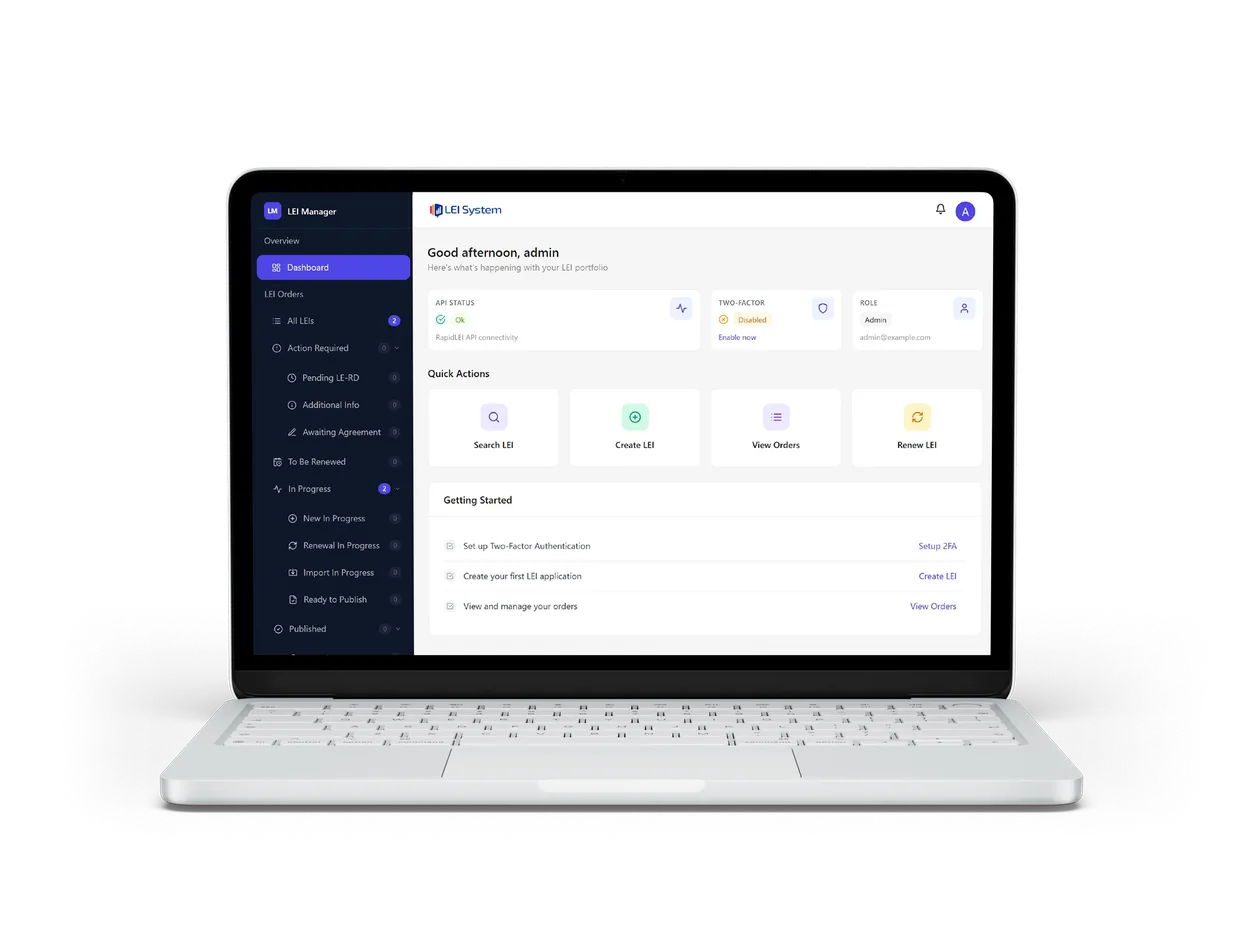
| Tracking LEI renewal dates across dozens of clients on spreadsheets is error-prone | LEI Manager's dashboard tracks every client's code status and renewal date automatically |
| A lapsed client LEI is permanently visible in the GLEIF Index history | Automatic annual renewal keeps every client code in ISSUED status year-round |
| Registering LEIs for each client individually doesn't scale as a portfolio grows | Bulk registration issues codes for many client entities in a single upload |
| Per-LEI costs add up fast across a large client base | Volume pricing reduces per-LEI cost as your managed portfolio grows |
| Clients want proof their LEI compliance is being actively managed | Portfolio-level status reports demonstrate proactive management to clients |
Beyond the compliance obligation, this is where the LEI actually gets used day to day.
Run a company LEI number search when taking on a new client to confirm whether an LEI already exists before registering a new one.
Look up an existing client's LEI number of company records when a counterparty or regulator asks for confirmation of an active identifier.
Register LEI codes for an entire newly-acquired client portfolio in one batch, rather than working through each entity's application individually.
Update a client's LEI record when their legal name, address or ownership structure changes, keeping the GLEIF record accurate and fully corroborated.
Generate a portfolio-level LEI status report to share with clients as part of your regular compliance reporting service.
Over 300 regulations worldwide now reference the LEI, which means a corporate service provider managing dozens or hundreds of client entities is effectively managing dozens or hundreds of separate compliance obligations, each with its own renewal date.
Handling that by spreadsheet or individual provider account scales badly: a missed renewal is invisible until a client's transaction fails. Centralizing LEI management the same way client filings and registrations are already centralized is simply the same operating model applied to a compliance obligation that happens to renew annually.
Client LEI compliance is the reason to centralize. What it changes operationally is the reason it's worth doing properly.
Client LEI compliance is the reason to centralize. What it changes operationally is the reason it's worth doing properly.
Automatic annual renewal processes every client LEI on schedule, rather than relying on a manual tracker to flag an upcoming deadline correctly every time.
When a client's legal name, address or ownership changes, the update flows through to their LEI record as part of the same administrative process, not a separate afterthought.
Offering LEI registration and renewal as part of a service package creates a new, recurring service line, and deepens the client relationship around an obligation that renews every year.
A centralized platform for the full LEI lifecycle across a client portfolio, not a series of individual provider accounts.
Manage LEI codes for every client entity from one LEI System account, viewing registration status, renewal dates and data accuracy for the whole portfolio at once.
Corporate service providers managing a large number of client LEIs qualify for volume pricing, reducing per-LEI cost as the portfolio grows.
| Portfolio Size | Management Approach | Typical Need |
|---|---|---|
| 1–10 clients | Individual registration, manual tracking | Occasional new registrations |
| 10–50 clients | LEI Manager dashboard recommended | Regular renewal and status tracking |
| 50+ clients | Bulk registration + volume pricing | Centralized management, API integration |
Individual registration works for a handful of clients. Providers managing a real portfolio need identifiers registered, tracked and renewed centrally.
LEI Manager is LEI System's platform for exactly that.
Explore LEI ManagerTrack every client LEI's status and renewal date from one dashboard, with automatic renewal so no client falls into lapsed status due to a missed deadline.
Connect LEI registration, lookup and status checks into the systems you already administer client entities with, via the LEI Manager API.
Register LEI codes for multiple client entities simultaneously instead of repeating the application for each one, ideal for onboarding a new client book at once.
Getting registered is a five-minute online process, not a paperwork exercise. Submit your entity's legal name and registration details, LEI System verifies them against official business registries, and your code is issued and published to the GLEIF Global LEI Index, immediately checkable by any counterparty or regulator who looks it up.

Pick a subscription plan and complete the online application with your entity's legal name, address and registration number.


Our system verifies your entity data against official business registries in real time, notifying if additional documents are needed.

Your LEI code is issued, recorded in the Global LEI Index and delivered to your email address along with a confirmation.
Every LEI System plan includes the GLEIF fee, lapse protection, and automatic annual renewal, so a code stays in ISSUED status for every transaction it is used in, not just the first one.

Kristian Hein, November 23
Europe is moving towards common standards for tokenised securities as digital technologies reshape capital markets. The new European Tokenisation Standards Group will focus on connecting financial systems and building on established industry standards. This article explores how the Legal Entity Identifier (LEI) and its digital counterpart, vLEI, support trusted identification, automated verification and interoperability across the next generation of financial markets.
Read more
Kristian Hein, November 18
The Financial Stability Board’s 2026 cross-border payments report highlights the UK’s CHAPS system as a live example of how Legal Entity Identifiers are moving into payment infrastructure. CHAPS handles everything from time-sensitive business and property payments to large financial-market settlements. Its financial-institution layer carries 73% of the value settled, making LEI data especially relevant for risk management, compliance, counterparty identification, and automated processing.
Read more
Kristian Hein, November 11
Does a branch need its own LEI, or should it use the head office’s code? Opening a foreign branch does not automatically create a separate LEI requirement. This guide explains the difference between branches and subsidiaries, when reporting rules call for the head office’s LEI, and when a branch may need its own. Find out what to check with your bank, broker or supervisory authority before applying.
Read more








 Affordable
 Lapse Guard
 Auto Renewals
 $94 total