

















































































How a Unique Business Identity Can Help Prevent Sanctions Screening Mistakes
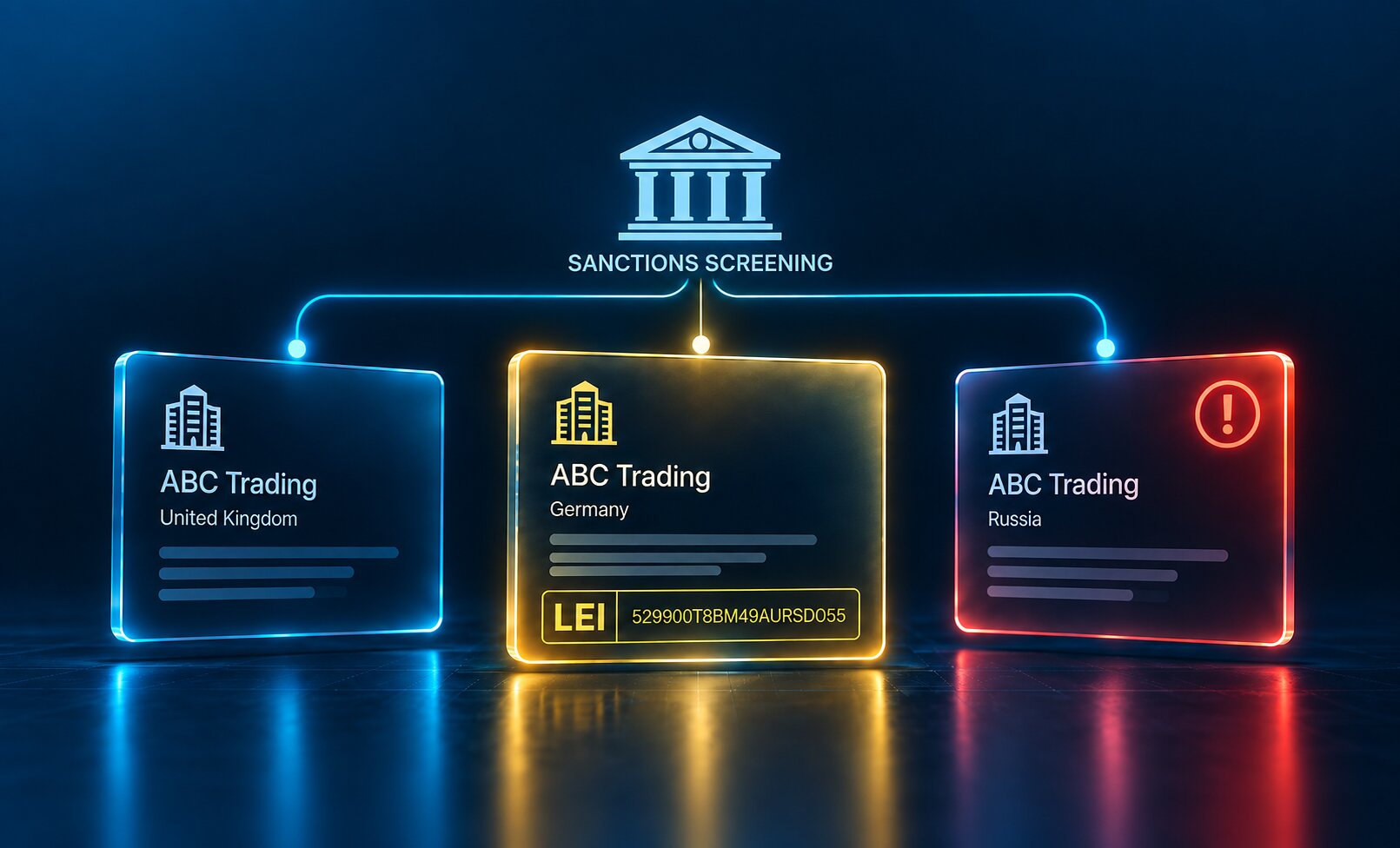
What happens if your company has the same, or a very similar, name as an entity on a sanctions list?
Your company is not sanctioned. Its owners are not sanctioned. It may have no connection whatsoever to the sanctioned entity.
But an automated screening system sees the name first.
In international payments, customer due diligence, and other financial services, banks and other regulated institutions screen parties against sanctions and other watchlists. When these checks rely on names and other conventional company information, similar names can generate potential matches that require further investigation.
This raises an important question that a company name alone cannot always answer:
Which legal entity are we actually dealing with?
The Legal Entity Identifier (LEI) provides a globally unique way to identify legal entities across borders. Sanctions screening is neither the original nor the only use case for the LEI, but GLEIF has increasingly focused on how the LEI can make sanctions and anti-money laundering screening more accurate and efficient.
The same name does not mean the same company
Company names are not globally unique.
Companies with the same or very similar names can operate in different countries. Translation and transliteration can also change how names appear, and different databases may record the same company under slightly different names.
In sanctions screening, this creates a real problem.
If a screening system finds a similar name on a sanctions list, it may generate a potential match. That does not automatically mean the company under review is sanctioned. Compliance teams need to evaluate the match using other identifying information.
Incorrect matches of this kind are commonly called false positives.
Incorrect matches of this kind are commonly called false positives. GLEIF has highlighted the problem of false matches in sanctions and watchlist screening and the potential for the LEI to make entity identification more precise.
A name tells you what a company is called. An LEI tells you which company it is.
An LEI is a 20-character alphanumeric identifier that uniquely identifies a specific legal entity.
Unlike a company name, an LEI is globally unique.
An LEI record connects this identifier with standardized reference data about the legal entity, including its official legal name, registered address, jurisdiction, and registration information. The Global LEI System can also provide Level 2 data describing parent relationships when GLEIF's reporting rules require or permit the reporting of those relationships.
This creates an important distinction.
If two companies are both called ABC Trading Ltd, their names alone may not provide enough information to distinguish between them.
If one has LEI A and the other has LEI B, the Global LEI System identifies them as two separate legal entities.
For sanctions screening, that distinction can be highly valuable.
How does the LEI help with sanctions screening?
Traditional sanctions screening often compares names, addresses, jurisdictions, and other identifying characteristics.
The LEI adds another tool: a standardized and globally unique legal entity identifier.
When both the company under review and the relevant sanctions or risk data contain an LEI, systems can compare the identifiers directly. LEIs can also provide a common reference point that connects information about the same legal entity across different datasets.
This helps to:
distinguish between companies with identical or similar names;
reduce false positives caused by name-based screening;
connect information about the same legal entity across different databases;
accelerate the investigation of potential sanctions matches;
improve the precision of automated compliance processes.
GLEIF has explored sanctions screening as an LEI use case with several organizations across the financial and data industries. GLEIF has also worked with OpenSanctions and Open Ownership on an initiative known as the Transparency Fabric.
At the heart of this concept lies a simple idea: use the LEI as a common identifier to connect different datasets.
The Transparency Fabric shows where this is heading
The Transparency Fabric developed by GLEIF, OpenSanctions, and Open Ownership brings together legal entity identity, ownership information, sanctions data, and other relevant information.
The LEI acts as a common identifier that helps connect information from different sources to the same legal entity.
This matters because financial crime screening involves more than checking whether a particular company name appears on a sanctions list.
Compliance teams may also need to underst which other companies and individuals have links to that company.
Through the Transparency Fabric, GLEIF, OpenSanctions, and Open Ownership have demonstrated how LEIs can connect legal entity information with ownership and sanctions data. The initiative also demonstrates how this approach can help map more complex corporate relationships.
This illustrates a broader value of the LEI.
The identifier does not need to contain all the risk information itself. Instead, it provides a common reference point that can help connect information from different sources to the correct legal entity.
Does having an LEI mean nobody can confuse your company with a sanctioned entity?
No.
This distinction is important.
An LEI does not prove that a company is free from sanctions. It is not a compliance certificate, and having an LEI does not guarantee that a bank will process a payment without additional checks.
Not every sanctions list, bank, payment provider, or screening system currently uses LEIs.
Therefore, an LEI cannot eliminate all false positives.
What the LEI does address is one of the fundamental problems in sanctions screening: it helps establish exactly which legal entity the system or compliance team is checking.
As more payment systems, sanctions datasets, and compliance processes incorporate LEIs, the practical value of this precise identification can grow.
The value of an LEI goes beyond regulatory compliance
Many companies first encounter the LEI when a bank, broker, or another financial institution tells them they need one for a particular transaction.
As a result, many companies see the LEI simply as a regulatory requirement.
But the idea behind it is much broader.
An LEI gives a company one global identity that financial systems and other organizations can use across countries and registries. The Global LEI ecosystem provides a common framework for identifying the same legal entity across jurisdictions.
Sanctions screening provides a good example of why this can matter to the company itself.
A company has an interest in making it as easy as possible for a bank, payment provider, customer, or business partner to establish: this is exactly the company I think I am dealing with.
Not another company with the same name.
Not a similarly named company in another jurisdiction.
And not a sanctioned entity that simply happens to have a similar name.
The same principle also matters in Know Your Business (KYB) and business partner verification, where companies need reliable information about the identity, legal status, and ownership of their counterparties.
The LEI as a connecting point for global business identity
GLEIF's work on sanctions screening, cross-border payments, and corporate ownership points to a broader development.
The role of the LEI continues to expand beyond its original use in financial transaction reporting.
Organizations can use the same identifier to connect a company with registry information, ownership relationships, financial market data, sanctions information, and other risk data.
A common identifier matters because databases do not always describe the same company in exactly the same way. Names can vary. Addresses can change. Different systems can use different formats and local registration numbers.
The LEI provides a consistent reference point.
Not every financial or compliance system currently takes full advantage of this capability. Adoption varies between markets, datasets, and organizations.
But the underlying principle is straightforward: the more precisely a digital system can identify a company, the less it has to rely on a name alone.
In sanctions screening, that can have very practical value.
LEI, AML, and sanctions screening are connected, but they are not the same thing
Sanctions screening forms one part of the broader financial crime compliance framework.
AML processes can include verifying a company's identity, understanding its beneficial ownership, and assessing customer and transaction risks. Sanctions screening focuses on identifying whether a party, or potentially a related person or entity, matches a person or organization subject to sanctions.
The LEI can help both processes address the same fundamental question: Which legal entity are we actually talking about?
We have explored the LEI's broader role in anti-money laundering in our article on LEI Codes and Anti-Money Laundering.
Should your company have an LEI for this reason?
If regulations already require your company to have an LEI, the answer is straightforward.
Without such a requirement, the practical benefit depends on the countries, financial systems, and business relationships in which your company operates. It also depends on whether your banks, payment providers, counterparties, and compliance systems use LEIs in their identification processes.
If your company does not yet have an LEI, you can register an LEI with LEI System. If you already have an LEI with another provider, you can transfer your LEI to LEI System while keeping the same LEI code.
But companies do not need to consider the value of an LEI only through one question: “Does the law require us to have one?”
There is another question worth asking: “When another company or an automated system checks our business, how easy is it to establish that we are exactly who we say we are?”
Company names can change. Other companies can share the same name. Registration numbers generally work within national or jurisdiction-specific systems.
The LEI offers something different: one globally unique identifier linked to standardized reference data about a specific legal entity.
Sanctions screening is one area where the value of that distinction becomes particularly clear.